
MP4
Basics
A widely used container for H.264/H.265 video and AAC audio.
Advantages
Broad device, browser, editor, and social-platform compatibility.
Limitations
Quality can decline when a lossy MP4 is encoded again.
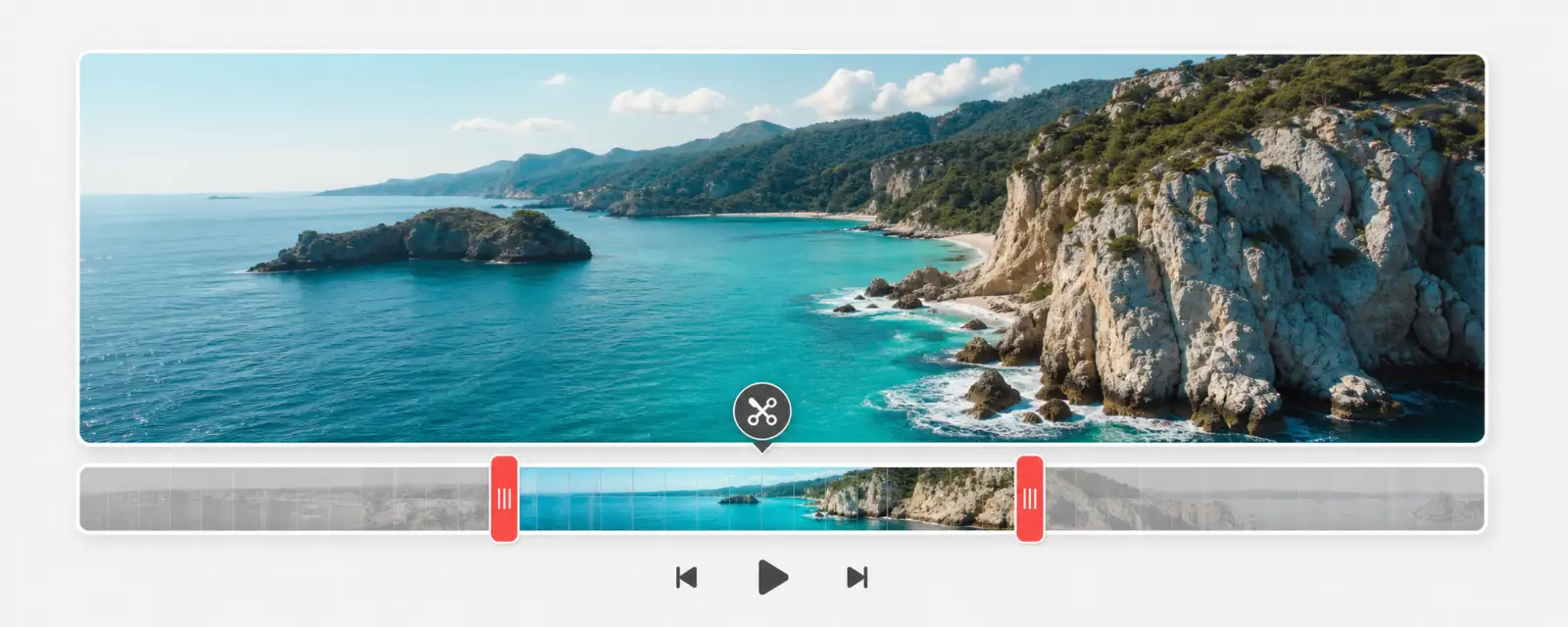
Keep only the part of a local MP4 video you need. Trim points are precise and your video never leaves your browser.
Choose a video to begin.
About MP4 trim
Trim a local MP4 video to keep the section you need without uploading the file. Choose precise start and end times, preview the result, and download a compatible MP4 clip.
MP4 is the most widely supported video container, commonly carrying H.264 or H.265 video with AAC audio. It is a practical choice for sharing, uploading, and playback across current devices.
Best for
Sharing, social uploads, and everyday playback.
Working with MP4
Use Balanced compression first. Reduce the resolution only when the file must meet a strict upload limit.
Select a local file. It is processed only on your device.
Enter the start and end time for the part you want to keep.
Preview the trimmed MP4 and download it when it is ready.
Supported input formats
MP4, WebM, MOV, MKV, AVI, FLV, and TS are accepted. A container alone does not guarantee compatibility: the video and audio codecs inside the file must also be available in the browser's FFmpeg runtime.
Basics
A widely used container for H.264/H.265 video and AAC audio.
Advantages
Broad device, browser, editor, and social-platform compatibility.
Limitations
Quality can decline when a lossy MP4 is encoded again.
Basics
A web-focused container commonly paired with VP8, VP9, or AV1 video.
Advantages
Efficient for modern web playback and royalty-free workflows.
Limitations
Some older devices and desktop editors have limited support.
Basics
Apple QuickTime's container, often used by cameras and editing software.
Advantages
Strong fit for Apple and professional production workflows.
Limitations
High-quality files can be large and less convenient outside Apple tools.
Basics
A flexible Matroska container that can hold multiple audio, subtitle, and chapter tracks.
Advantages
Useful for archives and videos with multiple languages or subtitles.
Limitations
Native playback support varies across browsers, TVs, and phones.
Basics
A legacy Microsoft container used by older Windows applications.
Advantages
Often useful for preserving or importing older media libraries.
Limitations
Files tend to be larger and are less suitable for current web playback.
Basics
A legacy Flash Video container from earlier web-video workflows.
Advantages
Helpful for converting older archives into modern files.
Limitations
Flash is deprecated and current browser support is limited.
Basics
An MPEG Transport Stream container common in broadcast and HLS segments.
Advantages
Resilient for transmission and common in streaming pipelines.
Limitations
Less convenient for editing, sharing, and seeking than MP4.
Related video tools
Reduce video file size with quality and resolution controls.
Export still PNG or JPEG images from a video.
Add text or a custom image watermark to a video.
Turn a short MP4 clip into a shareable GIF.
Trim WebM videos directly in your browser. Keep the part of your video you need.
Trim MOV videos directly in your browser. Keep the part of your video you need.
Trim MKV videos directly in your browser. Keep the part of your video you need.
Trim AVI videos directly in your browser. Keep the part of your video you need.
Trim FLV videos directly in your browser. Keep the part of your video you need.
Trim TS videos directly in your browser. Keep the part of your video you need.